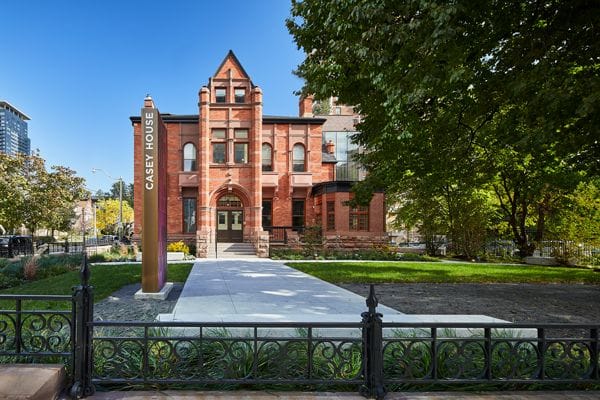
For nearly four decades, Casey House—Canada’s only dedicated HIV hospital, and one of Toronto’s smallest hospitals—has stood strong as a refuge for those struggling with the virus. Initially launched as a hospice for people dying from AIDS-related complications, the hospital has since pivoted to providing all kinds of care for its local community—from mental health and substance-use counselling, to massage therapy to the distribution of hot lunches.
But it hasn’t been able to offer general healthcare, like the type you’d receive from a family doctor. That is, until now.
As of last month, Casey House began offering family doctor spots to anyone who goes through their intake process, regardless of HIV status—even if they’ve never interacted with the hospital before.
It’s a significant evolution, not only for its scale—more than 2,200 people will be able to register with a doctor through Casey House in this first year—but also for what it says about our relationship with HIV and AIDS today. Much has changed since HIV cases peaked in Canada during the 1990s. Medications like PrEP and PEP are highly effective at preventing the virus’s transmission, HIV treatments have become more affordable and widely available, and it’s been proven that people on such treatments can’t pass on the virus. Partly because of HIV’s lowered health risks, organizations like the AIDS Committee of Toronto (ACT) have closed their doors.
Casey House, meanwhile, has been serving people without HIV for years, and now they’ll be able to do even more of that work. According to those who work at Casey House, it’s a change that builds on the organization’s longheld goals.
“In the first annual report of Casey House, on the very first page, it said that once HIV was solved, then we would go on to serve people with other diseases,” says Joanne Simons, Casey House’s CEO. “And so even in that first year, they were saying that we will continue to evolve to meet the community’s needs, whatever they may be.”
Though HIV has not been cured or “solved,” Simons says she’s seen the impact of the work her team has done outside of caring for people with the virus. Their hot meal program, for instance, has been a great attraction for people in the surrounding area.
But primary care has long been the missing piece, says Dr. Ed Kucharski, Casey House’s chief medical officer. “We have physiotherapy, nurses, occupational therapy, mental health support—but we don’t have a nurse practitioner or doctor who can diagnose and prescribe,” says Kucharski. That means someone might come into Casey House for a hot meal with a cut on their arm or an infection in their foot, and Casey House wouldn’t have a formalized system to treat the whole person (though Kucharski says the team would often call on their colleagues at Casey House or other institutions to step in and help anyway).
In fact, Kucharski and his team noted that the bulk of people coming to Casey House either didn’t have a regular doctor, or had one but hadn’t talked to them in years. “Either because there weren’t appointments available, or they had core experiences with stigma or discrimination and wouldn’t return back.” This is a big issue, he says, because early detection of infections or other health issues through primary care can do a lot in diverting later emergency room visits.
“It’s that ongoing relationship and that completeness in care—that’s the value,” says Kucharski.
In Spring 2025, when the Government of Ontario announced their plan to spend $2.1 billion on creating more primary care spots, Casey House saw it as their opportunity to finally link their clients and others in the area with a regular doctor. To make sure the community would actually take them up on it, they polled just over 100 of their 2,000 current clients that summer. They found that more than two-thirds said they’d be interested in coming to the hospital for primary care. Now, a year later, they’ve been approved and funded by the province to provide primary care to about 2,200 people.
Access to primary care is an issue that impacts the queer and trans community deeply. In Pink Triangle Press’s 2026 review of health disparities in Canada, a shortage of doctors and other healthcare professionals was identified as the number-one most pressing healthcare concern by LGBTQ2S+ people—with long wait times and struggling to find primary care coming in second and third.
“Close to two million Ontarians do not have access to primary care—and for our populations, we know it’s even more challenging because of all the marginalization, racism and discrimination,” says Simons. “This is the place that they trust.”
The latest in a series of evolutions
That trust has been built—and tested—for decades, beginning in the 1980s. June Callwood—a journalist and activist—saw scores of young men dying of HIV alone in their homes, isolated from friends and family. Callwood felt deep empathy for these men, inspired in part by the loss of her son Casey. In 1982, the 20-year-old had died after having been hit by an impaired driver.
Callwood began visiting these HIV-positive men at home, offering company and comfort. The home visits were funded as a program under ACT, but after seeing their positive impact, Callwood enlisted the help of fellow writer and advocate Margaret McBurney to incorporate Casey House in 1986 as a charity (named after her son). In 1988, with funding from the Ontario government and community donations, Casey House opened its physical location at 9 Huntley Street—becoming the country’s first HIV hospice.
“It became a space of compassion, dignity and care for people to die where there was no stigma associated either with being queer or having been diagnosed with HIV,” says Simons. At the time, life expectancy for those with the virus was between 10 and 15 months, so the building was a place for people to live their remaining weeks in comfort and acceptance.
While other nurses and doctors kept their distance from HIV patients—donning surgical gear even for the briefest of interactions—Casey House quickly became an international model for compassionate care. In 1991, the hospice was famously visited by Princess Diana. Photos of that visit set an example worldwide, showing that those with HIV could and should be touched, respected and loved.
But as HIV medications advanced, the life expectancy of HIV-positive patients with access to meds grew to match that of the HIV-negative population. As such, Casey House pivoted its 13 hospice beds to in-patient care for those with severe infections. It also began doing more community and outpatient care. As early as 2001, its staff started venturing out into the streets, offering meals and healthcare to unhoused people, regardless of HIV status.
Aided by donors, they were able to expand into a neighbouring building on Isabella Street, increasing their care capacity. Recognizing these many changes in the work being done there, Casey House officially transitioned from “hospice” to “hospital” in 2016 under Ontario’s Public Hospitals Act.
As Casey House grew, so too did the local Toronto community’s needs. Their outpatient program—which largely engaged unhoused people and substance users, regardless of HIV status—ballooned from a few hundred to a few thousand people. Though there may have been fewer people with the virus walking through its doors, Casey House became known for its particularly understanding treatment of substance users.
In 2021, Casey House became the first Ontario hospital to provide around-the-clock safe-consumption services, working to prevent and reverse overdoses. They also offered people sterile methods to take drugs, and to test drug supplies.
Traffic in and around Casey House significantly increased last summer when the Ontario government closed down nine safe consumption sites, including four in Toronto. “Before we were seeing 20 to 30 people a day, and last summer we were seeing a couple hundred people a day,” says Simons.
Such an influx of people seeking substance-use care put a pressure on the site. Neighbours began to complain of noise, theft, odours and vandalism.
“Certainly the neighbourhood, which has embraced us for almost 40 years, was really concerned about the activity around the building,” says Simons. “So we did a lot of consultation and conversations.” That included not only helping neighbours understand why so many people were being redirected to them but also hiring more staff and being diligent in discouraging service users from congregating in the area.
Still, with the Ontario government defunding eight more safe-consumption sites this summer, Simons is bracing for another influx of people seeking care. This time, though, she says her and her team are more ready.
Casey House’s expansion into primary care
Simons doesn’t think Casey House’s history with HIV and substance-using patients will deter those seeking primary care from entering the building.
“When I first started at Casey House [a decade ago], the doors were locked and you had to fill out a confidentiality form,” she says. “So we’ve had a lot of conversations with our clients about what it means to share a space, and what respecting other clients means.” This means that, yes, someone accessing primary care through Casey House may interact with those living with mental health or substance-use issues, and there needs to be a degree of respect and understanding so that everyone can access the care they deserve. Primary care clients may be encouraged to find a doctor elsewhere if they’re not living up to that expectation, says Simons.
Casey House also added five new clinic spaces for primary care on their second floor, funded by private donations. They’ll also be taking on more doctors and nurses to deliver the additional care.
It’s a kind of care that people often take for granted. For instance, when Toronto-based Simon Rayek first moved to the city from his hometown of Oshawa in 2010, he didn’t think he needed to find a doctor. “I figured if I got really sick, I would go to an urgent care clinic,” he says. “I didn’t even know that having my own family doctor was important.”
Five years later, Rayek would be diagnosed with HIV while getting routine sexual health testing. The idea of going back to his childhood family doctor in Oshawa for care was a non-starter. “Oshawa is not the most open-minded place—I wouldn't have been comfortable.” Instead, he found a queer doctor downtown who specializes in HIV and makes him feel at ease. Still, he sees that many of his friends are still struggling to find primary care.
“It’s difficult to engage properly in the healthcare system if you don’t have a doctor—if you don’t have somebody that you trust, that knows your medical history,” says Rayek. But having a primary care doctor who will understand your needs and won’t stigmatize your medical history can make a world of difference.
For those looking to become primary care clients at Casey House, Simons says it’s as simple as arranging an intake session. There, a counsellor will ask about your health needs, history and help to determine whether Casey House is the right fit. The only qualifications are that you be at least 18 and preferably someone with or at risk of HIV—such as LGBTQ2S+ people, African, Caribbean and other Black communities, Indigenous people, sex workers, substance users or others who are street-involved. (Though exceptions may be made.)
It may sound like a simple change—primary care being added to the long list of services Casey House already offered—but the Casey House team is clear: this is “generational change.”
“I got into family medicine because I believe in it so much—preventing something from happening is much more effective than dealing with it later,” says Kucharski. “By offering primary care, we can play an even more fulfilling, meaningful role in someone’s life.”