Despite first witnessing it decades ago, there’s a moment in Buffy the Vampire Slayer that still shapes how I think about the concept of strength. In the series finale, the titular character, Buffy—a 23-year-old woman who’s been battling monsters and demons since adolescence—asks a group of young women and girls in a moment of terrible crisis, “Are you ready to be strong?”
These young women are Potential Slayers, whose destiny it is to follow in Buffy’s footsteps, to rise up and fight to change the world—if they so choose.
The moment stuck with me, a quintessential nerd and child of the 1990s, over the next twenty-odd years. It was a question I’d ask myself over and over again as I came to terms with myself as queer person and a trans woman, a person with chronic illness, an abuse survivor and a sex worker in a world that rejects and ridicules all of the above: Am I ready to be strong? The question still haunts me.
Am I ready, in 2026, for a world where anti-trans legislation and anti-trans sentiment have become one of the central pillars of the fascist and authoritarian ideology that now runs most of our world? Where the worth of trans women’s lives seems to diminish in the eyes of the dominant culture with every passing day?
What would that even mean, to be ready to defend ourselves, especially as communities of disabled people, chronically ill people, of people whose bodies are constantly subjected to the criticism of being “weak” or “unfit?”
Thinking about these questions, I find myself getting confused. There’s a part of me that lives in constant fear, constant shame. How many trans women would say the same?
Here’s what I know for certain: When I was 14, a homophobic bully was going around telling the people in our high school class that I was a fag and he was going to beat me up, so I challenged him to a fist fight in the middle of gym class in front of all the other kids. The fear in his eyes as he stammered and blustered and slunk away with his tail between his legs was delicious. That was the last time that I felt so strong.
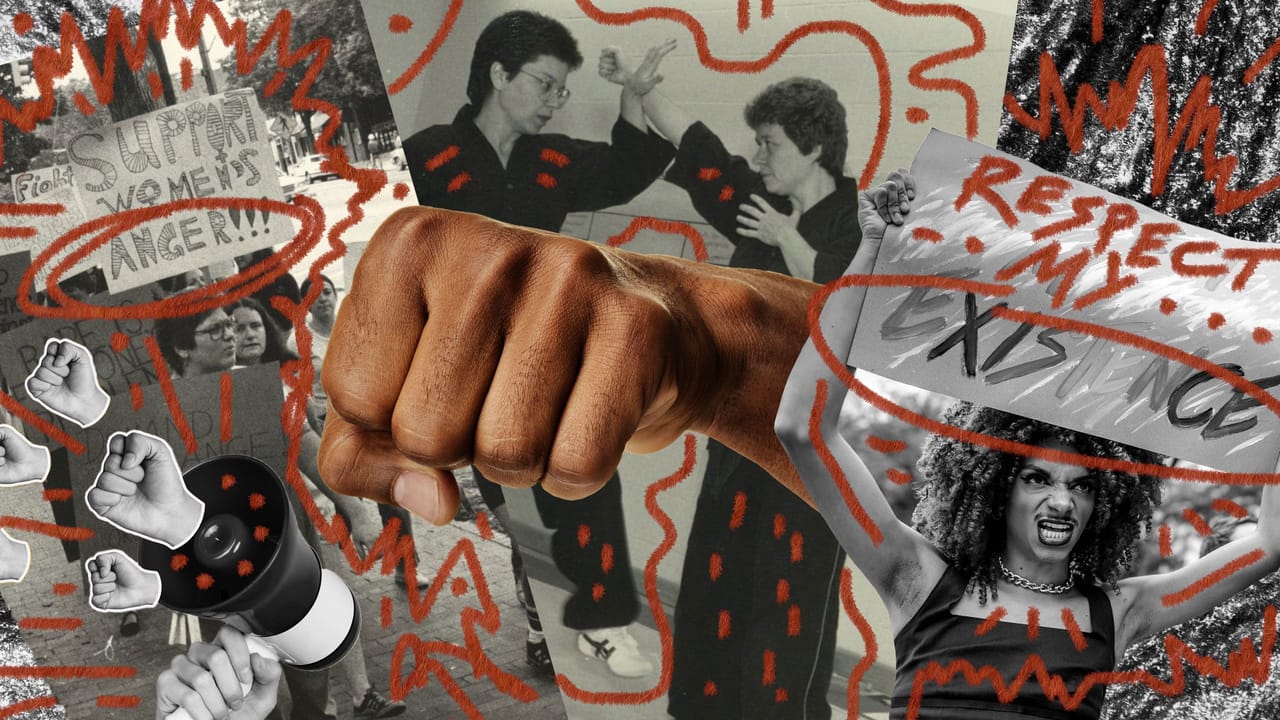
Twelve years later, I was the only trans woman in a Wen-Do women’s self-defence class, and the instructor was teaching us the “hammer fist,” a type of punch commonly taught in self-defence courses. As my hand hit the boxing pad and the sound cracked the air, a surge of electricity raced through my body. The impact, that sound, it felt so good and so scary all at once. It was like really good sex. No, it was better.
All our lives, women and girls are taught that we are not allowed to be strong, and even less allowed to be dangerous. Trans women and transfeminine people are doubly forbidden from accessing our dangerousness, because unlike cis women, trans women are not allowed to be righteous victims in the eyes of the dominant culture. Decades of being portrayed as sexual deceivers, sociopathic monsters and depraved villains who prey on children have made these faulty depictions the default view of trans women, which means we are guilty unless proven innocent.
A dangerous cis woman is—occasionally, and under the right circumstances—seen as necessary, admirable or even sexy, like Buffy the Vampire Slayer or Uma Thurman’s character in Kill Bill (notably both white, blonde characters created by white heterosexual men). A dangerous trans woman, however, can never be righteous, only repulsive. She can never be a victim, only a predator—or, in more recent years, a terrorist.
Women and girls are taught that we are not allowed to be strong, and even less allowed to be dangerous.
Maybe it’s no wonder, then, that I’ve never met another trans woman in a self-defence class. After all, a class of people who are automatically labelled predators cannot be said to be capable of self-defence, only of causing harm. In a world that hates and fears us, defending ourselves is seen as violence, while violence committed against us is seen as justified.
The distinction between violence and self-defence has always been political, and also more complex than it first appears. For example, the women’s self-defence movement finds its origins in the suffragette movement of the late 19th century, and primarily focused on middle-class white women defending themselves from attackers outside the home, who were often assumed to be racialized, migrant, poor and working-class men. The result was that white women of privilege were able to achieve a measure of empowerment in exchange for reinforcing cultural systems of capitalism, imperialism and white supremacy.
In the 1970s, second-wave feminism brought about a resurgence of the women’s self-defence movement, emphasizing the dismantling of rape culture and undoing the social conditioning that causes women to see ourselves as weak. This version of the movement brought a greater understanding of domestic violence to the fore, particularly the reality that the vast majority of sexual violence is perpetrated by individuals known to the victim/survivor, most often a friend or family member—thus challenging the idea that immigrant men, Black and brown men and poor men are more likely than other men to commit sexual violence.
Yet tensions within second-wave feminism, and its ambivalence about gender and sexual diversity, continue to trouble the practice and teaching of self-defence today. For many trans women and transfemmes, who are often the targets of hatred from self-styled “radical feminists” of both the 1970s and current times, self-defence remains a deeply loaded, and often painful, topic.
Within trans women’s culture, there are many terrible stories of sisters and siblings, particularly Black and brown trans women and transfemmes, imprisoned and punished for defending themselves: CeCe McDonald, for example, was sentenced to 41 months in prison for defending herself from fascist and transphobic harassment, and Moka Dawkins was similarly imprisoned for killing a man who attacked her by stabbing her in face with a knife, unprovoked.
Perhaps this is why Transfighters Oakland collective writes in their zine A Self-Defense Study Guide for Trans Women* (according to Transfighters Oakland, the star stands for “and other people affected by transmisogyny”) that “bystanders and crowds almost always side AGAINST trans women*, even crowds of trans people. This is especially true if the crowd is white and the trans woman* is not,” and, “trans women* should expect & plan for crowds & allies to let them down or even turn against them.”
As a result, many of the Transfighters’ suggested strategies are aimed at enforcing one’s boundaries and escaping threatening situations while managing the perceptions of bystanders and the risk of judicial sentencing as much as possible. This is an essential skill set for a population that’s constantly and increasingly being demonized by lawmakers and political pundits as a threat to society. Indeed, I think that this is the skill set that I tend to rely on most of all in day-to-day public life, and sadly, it’s one I believe every trans woman has to learn.
In my secret heart, though, deep down where the shame and anger of a lifetime hide, I dream of a world where trans women’s fury and ferocity are allowed to exist in public. Where our voices shake the heavens and our fists shake the earth and are seen for the gift that they are rather than a threat to be destroyed. What would be possible in a world like that? Where we didn’t have to hide or fear our strength?
The women’s self-defence movement of the 1970s knew that the reclamation of self-defence as a collective capacity is essential to the dignity of human beings. In a 1975 press release, the Women’s Martial Arts Union wrote, “The right to self-defense is one of the most basic human rights. It is usually one of the first rights denied to an oppressed group by their oppressors.” Whether or not the writers were thinking about trans women, the statement rings as true today as it did 50 years ago—for trans folks, for racialized folks, for all oppressed peoples.
Over the years since that first women’s self-defence class, I’ve found myself returning to various forms of self-defence. Today, I am an instructor in the Empowerment Self-Defense (ESD) movement, the direct successor to the feminist self-defence movement. ESD aims specifically to train the broadest range of marginalized people, stating on their professional association’s website that ESD serves not only cis women, but a wide range of marginalized communities, specifically noting gender, racial and physical diversity.
The breadth and inclusiveness of this mandate was what led me to seek out training as an instructor with Empowerment Self-Defense Canada (an organization that I discovered to be delightfully queer and trans-positive in all the ways, with fabulous trainers).
Like most models of community-based self-defence, ESD doesn’t just teach physical strikes or grappling moves. It instead focuses on a broad range of strategies, such as situational awareness, education on how and where violence occurs, verbal methods of both de-escalation and defence and getting support from trusted people. Yet the thing I love most about those moments is when I get to hit the pads, to raise my voice, to feel my strength. Those moments—fleeting and precious—when my ferocity takes form, when it lives and breathes and is celebrated in community.
Is this what it means to be ready to survive the moment? If trans women were to practise releasing our ferocity, our strength, our rage and our grief together, would that make us more capable of protecting ourselves and each other? Could embracing the very thing we’re punished for somehow help to free us? Is that self-defence? Or just self-delusion?
I’m thinking about all the trans women I know, still clinging to life in this moment of collapse and annihilation. Trans women who’ve been black bloc activists and advocates, trans women who’ve finessed their way out of poverty and homelessness by going stealth, trans women who’ve said fuck the gender binary and refused all definition, trans women who serve as healers and artists and mothers to our communities. Butch trans dykes, working in the trades, a famously conservative sector. Tech tgirls, forging a path through. Sex worker trans witches charming money out of men’s pleasure. Each one a death-defying fighter in her own way, each of us battling it out in our own way, every day.
There are so many ways to be strong. We deserve them all.