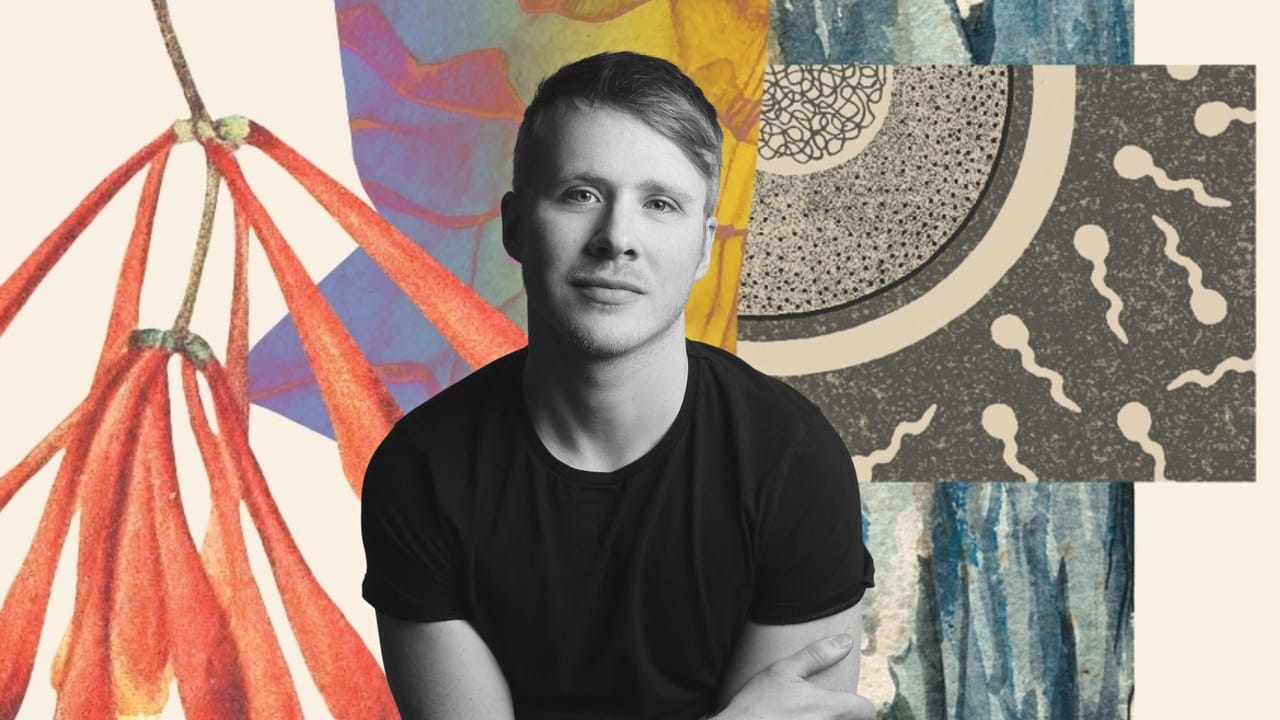
When Joe Osmundson was a child, he believed he would one day become pregnant. While that wasn’t, in reality, physically possible, the writer and biologist’s desire to become a parent continued into adulthood.
After years of joking about it, Osmundson, along with his best friend and her partner, decided in 2020 to try to co-parent a baby. Though initially it was just a wish to parent that brought them together, the group eventually elected to try to conceive all together: one gamete from Osmundson, another from his best friend and a womb from her wife.
The process wasn’t easy, as the trio faced the realities of IVF, the pressures of finances and changes to relationships, alongside Osmundson’s internal fears of climate change and the ethics of bringing a child into the world.
Osmundson captures the complexities of trying to “make a bio baby and a family with three people, across two partnerships and in two boroughs of the city” in his latest book, Spawning Season.
He says that “experiment” is the right word to describe his experience of trying to build a family. “The nature of doing scientific research is you are doing research on things that are inherently unknown. We were making the path under our feet as we were walking it.” Just like with science, Osmundson says, “We all went through various amounts of faith that the experiment would be one that worked.”
Ahead of the release of Spawning Season, Script spoke with Osmundson about his experiment in queer parenthood.
You’re a scientist who wrote a non-fiction memoir, yet the book makes heavy use of metaphors, and blurs the lines between fiction and reality. Why?
Language builds reality. We think in language. We build our experiments in a language. We write our papers in language—it is not inextricable from that. And then at an extreme excess of emotion—love, grief, lust, child-making—language breaks down entirely. I think life troubles the line between metaphor and reality in these excessive states.
Gender roles, specifically those around motherhood and fatherhood, are blurred as well. Why was that a central theme for you?
I feel pretty non-binary or agender. I know I present to the world as a cis man, probably a faggot. But motherhood was something that, from a very young age, I felt like I would inhabit. It had nothing to do with my body. You know, I wish I had a womb, because it would make it easier to have a baby. But I don’t feel discomfort in the way my body is gendered, overall.
My connection to the idea of motherhood growing up was more so that in the rural, working-class, white town that I was raised in, fathers were like my father: emotionally distant. That was the best possible thing you could have, because most fathers beat the shit out of their kids. Mothers, on the other hand, had the capacity to nurture, to care, to make food, to welcome you into their home with a hug. It was this different role that had much more safety in it for me as a young child. That’s how I wanted to orient myself to the children that I would have. My desire to be a mother had very little to do with gender, sex and body, and everything to do with the orientation of each of these roles I had as a young person.
You also tell the story in a nonlinear way, and are intentional about when you reveal certain things.
I wanted to bring the reader into the uncertainty my friends and I felt: it’s definitely going to happen; it’s not going to happen. It’s definitely going to happen. It’s not happening yet. I wanted to share that with the reader.
The process of trying to have a kid pulled all of these things that are sort of the default settings of adult life out of being a default setting: my relationship to my parents, my relationship to food. Every night as I was cooking, I wondered, will my child like this thing that I’m making? Where does this food come from? You’re forced to consider those things from a different point of view.
The book ties together science writing, food writing and memoir. As much as you spent time discussing the potential baby, you also discussed fishing, science and cooking. What made you want to tie together so many things?
The experience brought me to the form. All of those threads were things that I lived through during this massive experience of maybe-child-making. As I was dealing with all the very intense feelings of maybe and maybe not having a kid, I was thinking a lot about ecology and climate change. We referred to our kid that we were maybe making as a “little animal” and so that was an inherent frame for it.
I got really interested in the fact that many of us eat animals, wild animals, and then we also study the ecology of these very same animals. I can go out and tag them. I can sequence their DNA and figure out parentage. I can trap every salmon going upstream at a particular location and study the next generation and see how many offspring each of those salmon had. I also, if I need to eat badly enough, or need to feed my child badly enough, can go out and stand in a river, throw a thread out into that river with a handcrafted fly on it, reel in one of those fish, bash its head in, throw it on a very hot pan and put it in my body. And then the molecules from that ecological being, that sovereign, living animal, will become the molecules in my body. We do this every day.
Throughout the book you present a lot of conceptions of what parenthood can be, and what being an adult in a child’s life can be. What were you trying to achieve with that?
I think I was being heteronormative or homonormative about parenthood in a way that is hard not to be—that normativity was given to me through language as a child. The idea of, “This is what a family looks like: two parents, kids, households, and you sacrifice everything in your life for that structure.” I wanted to be that type of parent very badly.
When that ended up not being possible, I realized that I was completely ignoring the way that that type of relationship across generations was already in my life. I was depriving myself of that capacity and possibility because of the grief that I was feeling about not having my child.
I’m a teacher, so it is inherent to my life to have this intergenerational relationship with students. My friends have kids, and I can make active decisions to choose to be someone in those children’s lives. These relationships evidently aren’t the same thing as being a parent. But being a parent isn’t the only way to be in young people’s lives. It’s become a real joy when I do show up and I can have a regular relationship with my friends’ children, where we have that familiarity and that ease. They can know me as they get older. There’s a great amount of joy in that as well.
Do you have any advice for queer people who are considering embarking on similar journeys?
Be open to any option, be prepared for any outcome, listen to your body and be ready to be surprised by how you feel. Talk about money, because most options are expensive. Try to be as queer as possible, but don’t feel guilty for wanting normative things, too. Even if you’re trying to have a kid on your own—good for you!—don’t go it alone. The experience can be isolating. Whether you’re doing adoption, IVF or another method of getting pregnant, expect homophobia from the system—it will come eventually, even if you’re working with a team that’s trying to buffer you from it. Have support so that when it happens, you can talk about it. No matter how much work you think it’ll be, plan for the first year of parenthood as if it’s 10 times that amount of work, and plan for the isolation that comes along with that. Even watching this time from the outside is hard.
Maybe most importantly for and from me: if your parenthood journey ends without a child, you are not alone. Not a lot of people talk about it, but a lot of people who want kids won’t have them in the end. Your grief is valid, and will be much harder to live with if it’s avoided or minimized.