If you’re familiar with STI testing practices, you’re probably aware that anyone hooking up with multiple partners should get tested every three months—or every time they switch partners. What you might not know is that when it comes to STI testing, timing matters: getting tested immediately after a hookup with someone new doesn’t necessarily give you accurate information about the status of your sexual health.
Nolan Hill is a training-centre facilitator at the Centre for Sexuality in Calgary, which provides services like STI advising and sexual health education. He says that it’s common for people to assume that every single STI would be flagged at a routine screening. But, he points out, not every infection is tested for every time, and not all infections show up immediately on tests.
In Canada, for instance, HPV and herpes aren’t always included on routine STI tests, and are instead only tested for if a person shows up at a clinic with specific symptoms.
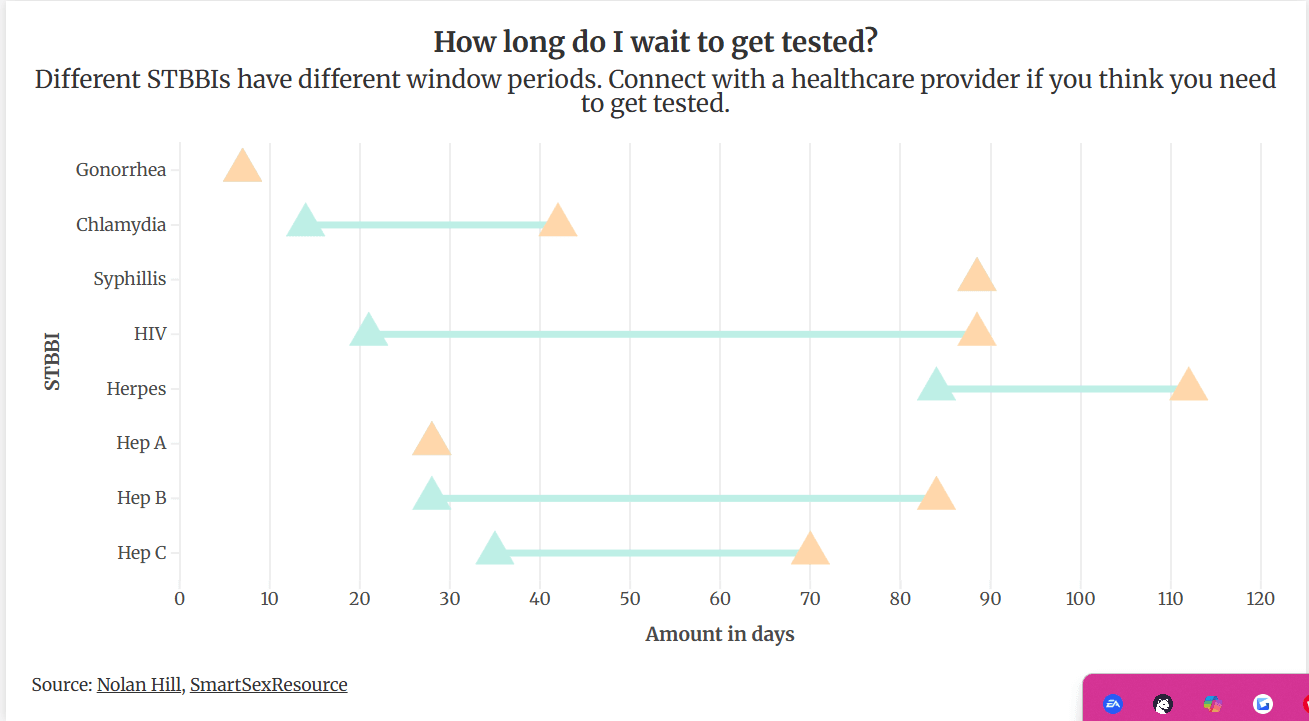
All STIs have a window period—in other words, the amount of time it takes for an infection to show up as positive on a test.
“We know that this window period can vary per infection. It can be anywhere from a handful of days for certain infections, all the way up to a few months, if not longer,” Hill says.
Even if an STBBI doesn’t get flagged during testing at first, Hill says it is still possible to expose someone else to the infection. It’s why understanding window periods is important for managing your sexual health. Script put together this guide to help you make the most informed decisions—and understand which STIs to test for and when.
Gonorrhea and chlamydia
Gonorrhea and chlamydia are two common and curable infections with similar testing procedures. But while gonorrhea is only likely to show up on a test seven days after contact, chlamydia takes two to six weeks.
Testing at clinics for gonorrhea and/or chlamydia is most often done via a urine sample or genital swab, and patients can usually expect to get their results back within a week. At-home tests are also available. For instance, DynaCare’s STI Home Testing Kit for gonorrhea, chlamydia and trichomoniasis allows patients to self-test at home, and returns results within five to seven days of the sample arriving in their lab.
Hill says that in Alberta, additional testing may be done for the rectal and throat areas. Other provinces, such as Ontario, do the same.
HIV
The window period for HIV has one of the biggest variances—it can take anywhere from three weeks to three months for HIV to show up on a test. Your healthcare provider may ask you to take an initial test at three weeks before taking another after six weeks because of this.
Testing for HIV is available for at-home and clinic tests, with rapid-testing options available for both. In clinical settings, a sample is often collected through a blood draw from the arm. For at-home or rapid tests, blood is drawn through a pinprick of the finger. At-home tests and some clinics are able to receive the results in minutes, while others may have to send the sample to a lab—results are sent back within several days.
Hill says that Canada has recently introduced oral samples for clinic and at-home testing this year, in which people swab their gums to obtain a sample. The window period for this test is 23 to 90 days.
Syphilis
Syphilis is another common yet curable bacterial infection in Canada. The window period for syphilis is three months for blood tests, but testing can be conducted sooner via a swab test if lesions are present.
Some labs may take about a week to return results, while clinics that offer rapid tests that can be performed on-site can give results within 20 minutes. At the moment, there’s only one option for at-home testing: a dual rapid HIV-Syphilis test, which was introduced in 2023.
Folks who routinely engage with new and/or multiple partners may be asked to be screened every three to six months, while “at-risk” groups may be asked to be screened every three months. This is defined as including people with HIV, men who have sex with men, incarcerated populations, some Indigenous communities or those who use drugs intravenously.
Herpes
Herpes tests are only recommended if you have a history of warts and/or lesions on your genital region, and are available in clinics or at home, with rapid-testing options also available. In a clinic, testing can be done through a blood or swab test.
Test result times can depend on the clinic and lab. Some places offer same-day results, while others take a few days. Rapid pinprick tests may be offered at home or in some clinics, with results delivered in 10 minutes.
Hepatitis C
Typically, the window period for Hepatitis C, or HCV, is five to 10 weeks. Similar to herpes, HCV isn’t usually screened for in routine testing unless you have specific symptoms, but you can request testing via blood test for this curable infection from your healthcare provider.
Both in-clinic and at-home testing options may be available, as well as rapid tests done via finger pinprick.
Tips for getting tested
Although different STIs require different testing protocols, the initial steps you can take to get tested are typically universal. Most at-home testing can be obtained online or through a specialty clinic.
Online tests are typically provided by the labs themselves. For instance, INSTI HIV Self Test is available for purchase directly from the lab via its website. EasyDNA’s Home STD (STI) Test, meanwhile, is also available online and includes testing for a variety of different STIs such as chlamydia, gonorrhea and trichomoniasis.
Some community organizations also offer at-home tests for free, such as SafeLink Alberta, which supplies free HIV self-testing kits to various clinics across the province, or the University of Ottawa project GetaKit, which provides free testing kits throughout Ontario and online.
Ultimately, Hill says it’s important that people connect with the healthcare system to figure out what the exact path they need to take looks like. If you are regularly having sex with multiple partners and are testing every three to six months, you’re likely going to be covered. But being armed with knowledge and understanding the tools and resources available to you is key. “Those are super helpful in terms of having some confidence going into that routine screening,” says Hill.